Deutsch
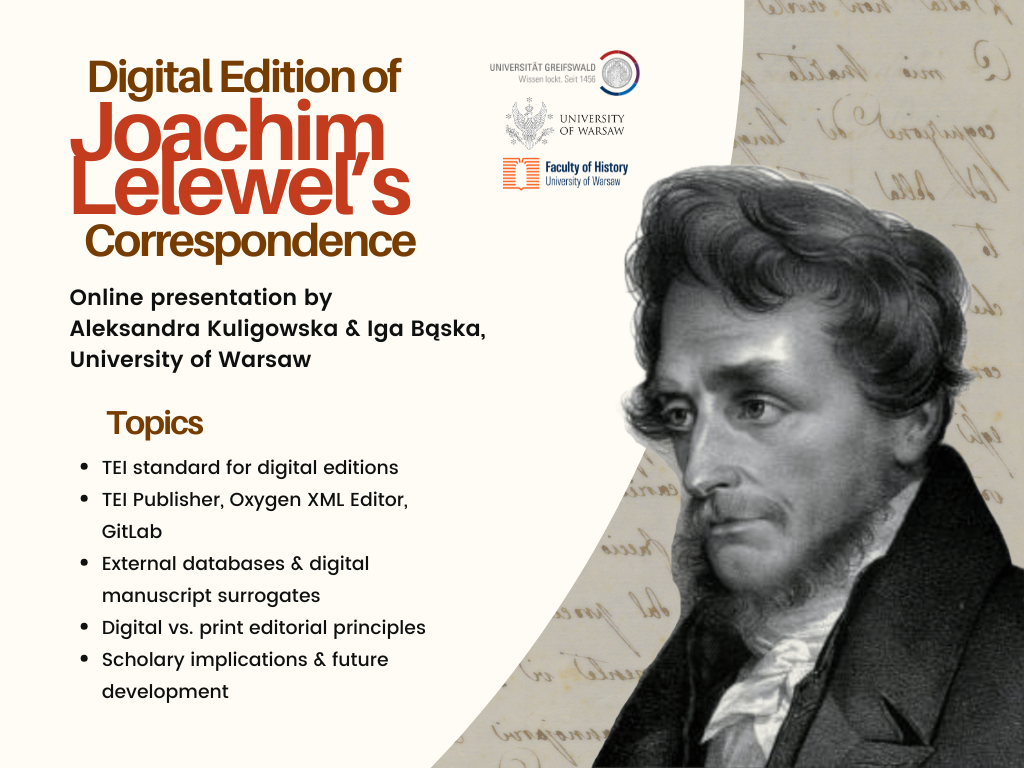
Am 22.01.2026 um 18:00 Uhr fand die Online Guest Lecture „Digital Edition of Joachim Lelewel’s Correspondence“ statt. Aleksandra Kuligowska und Iga Bąska von der Universität Warschau stellten das Digital-Humanities-Projekt vor, das die Korrespondenz des jungen Joachim Lelewel aus den Jahren 1799 bis 1811 in einer digitalen Edition zugänglich macht. Lelewel (1786–1861) zählt zu den bedeutenden polnischen Historikern und politischen Persönlichkeiten des 19. Jahrhunderts.
Der Vortrag gab einen Einblick in die methodischen und technischen Grundlagen der Edition. Im Fokus standen der Einsatz des TEI-Standards, der Arbeitsprozess mit TEI Publisher, Oxygen XML Editor und GitLab sowie die Nutzung externer Datenbanken für Annotationen und die Einbindung von Quellenfotografien. Zudem wurden Unterschiede und Gemeinsamkeiten zur gedruckten Edition diskutiert, darunter digitale Navigations- und Filtermöglichkeiten sowie neue Formen der Interaktion mit Text und Quelle. Abschließend skizzierten die Referentinnen Vor- und Nachteile verschiedener Lösungsansätze und zeigten weitere Nutzungsperspektiven der Edition auf.
Hier finden Sie das Projekt.
English
On 22 January 2026 at 6:00 p.m., the online guest lecture “Digital Edition of Joachim Lelewel’s Correspondence” took place. Aleksandra Kuligowska and Iga Bąska from the University of Warsaw presented a digital humanities project that makes the correspondence of the young Joachim Lelewel from 1799 to 1811 available in a digital edition. Lelewel (1786–1861) is regarded as one of the leading Polish historians and political figures of the nineteenth century.
The lecture provided an overview of the edition’s methodological and technical foundations. It focused on the use of the TEI standard, the team’s workflow with TEI Publisher, Oxygen XML Editor, and GitLab, as well as the use of external databases for annotations and the integration of photographs of the source materials. The speakers also discussed similarities and differences compared to a printed edition, including digital navigation and filtering options and new ways of interacting with the text and the sources. In conclusion, they outlined the advantages and disadvantages of different approaches and pointed to further possibilities for working with the edition.
You can find the project here.