
Copyright and Licences
Legal Framework for Open Access Publications
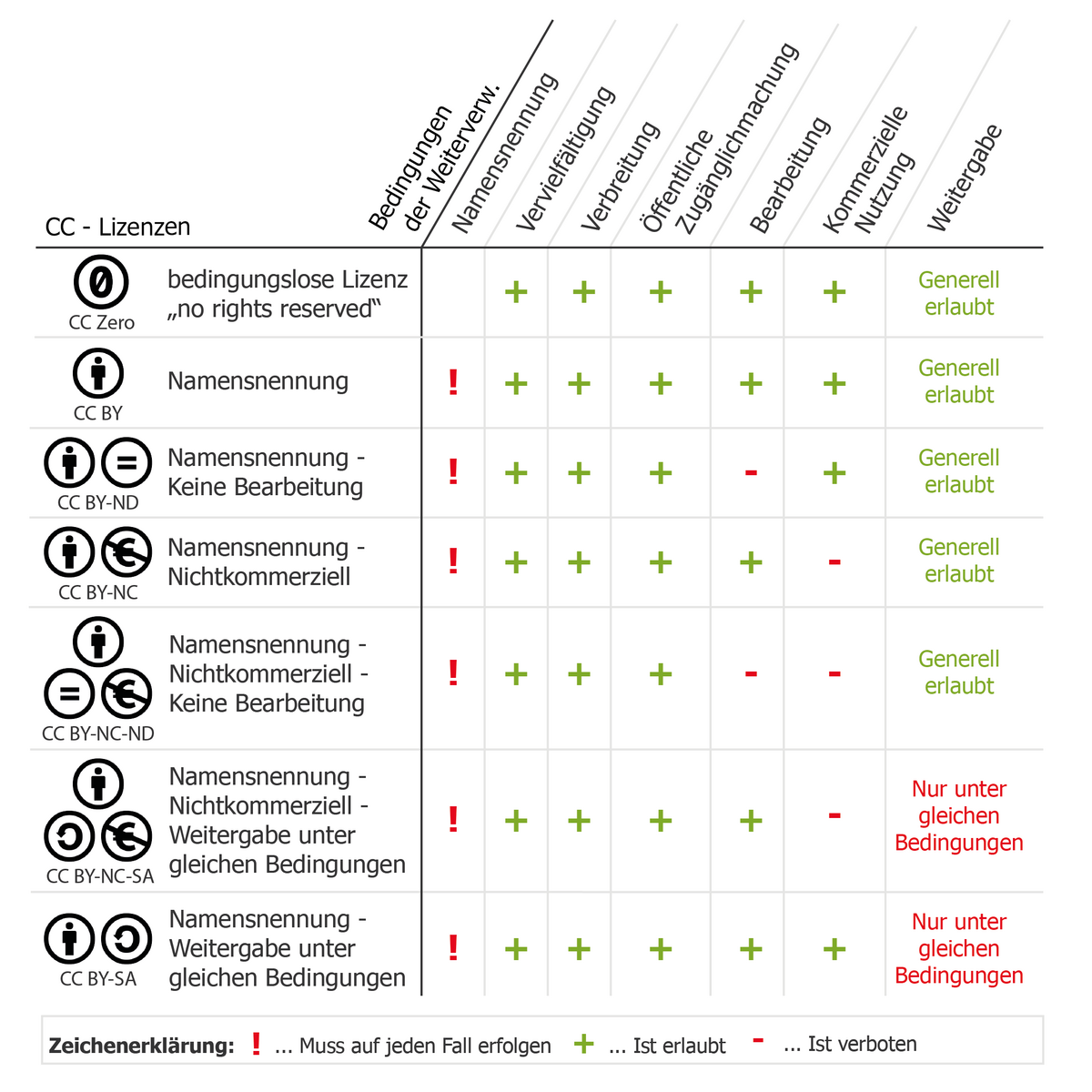
In the case of the first publication in Open Access, the author grants publishers simple rights of use so that further use by the author is possible. By choosing a licence, you decide under which conditions your published document may be used in the future. In its Open Access Policy, the University of Greifswald recommends the use of the CC BY 4.0 licence. This licence allows for maximum dissemination and reuse of your publication.
What are Creative Commons Licences?
Creative Commons licences (often referred to as ‘CC licences’) provide a simple way of granting rights of use to the general public. CC licences are based on copyright regulations, but they allow for more extensive use of the works than is usually provided in copyright law. This removes barriers to the dissemination of knowledge in the fields of research and culture, e.g. by enabling adaptations of the work in another language. In the context of Open Access, the CC-BY licence is recommended for scientific content. In the field of art and culture, restrictions on the adaptation of works or commercial reuse may be appropriate; therefore, unlike for scientific works, there is no blanket recommendation for a specific licence.
The moral rights of the author are not affected by a Creative Commons licence, i.e. the author must be named in every instance of use.
Open Access Team
University Library Greifswald
Service hours:
Monday to Friday 9am–11am
Telephone +49 3834 420 1531
openaccess@uni-greifswald.de
Legal Framework for Secondary Publications
Secondary publication in a repository makes it possible to make a publication available in Open Access that was previously only accessible behind a paywall. The University's Open Access policy recommends that its researchers actively exercise their right to secondary publication and, if possible, make all closed access publications additionally available in repositories, e.g. via the University's repository.
Right to Secondary Publication
Since 1st of January 2014 the Recht auf Zweitveröffentlichung (§38(4) UrhG), a right to secondary publication/self-archiving, has been in effect in Germany. It applies regardless of what has been agreed with publishers. According to this, many journal articles may be republished twelve months after their initial publication. If no other agreements are in place, the so-called ‘accepted manuscript’ (version after scientific review) may be used for this purpose.
If this right does not apply to your publication, the following information may be helpful:
According to § 38(1) Urheberrechtsgesetz, the Copyright Act, authors may publish their work elsewhere one year after publication in a periodically appearing collection (journal, anthology, etc.), unless otherwise agreed.
Secondary publication is possible without restriction and immediately if you have only granted the publisher a simple right of use or have expressly reserved the right to parallel publication.
Rights of Use in Secondary Publications
- The rights of use granted at the time of first publication can be found in your publishing contract. If you do not have this to hand, the Open Policy finder database can help you find your way around. It provides information on what different publishers allow with regard to the secondary publication of scientific publications. However, the overview is not legally binding. In case of doubt, the publishing contract applies.
- When negotiating your contract, make sure that you, as the author, grant the publisher the simplest possible rights of use. For guidance, use the SPARC Author Addendum as a template. This allows you to retain the right to publish the publication in whole or in part elsewhere (secondary usage rights). If possible, do not grant any exclusive rights of use in the publishing contract.
- If you have granted exclusive rights of use, ensure that you are granted the right to parallel publication (if necessary, after an embargo of 6 or 12 months).